Safe-Stop

Humanoid Safe Stop via Learned Stoppability Value

Junfeng Long1, Pieter Abbeel1,†, Koushil Sreenath1,†, Roberto Horowitz1,†, Guanya Shi2,†, C. Karen Liu3,†

1University of California, Berkeley   2Carnegie Mellon University   3Stanford University
Equal advising.

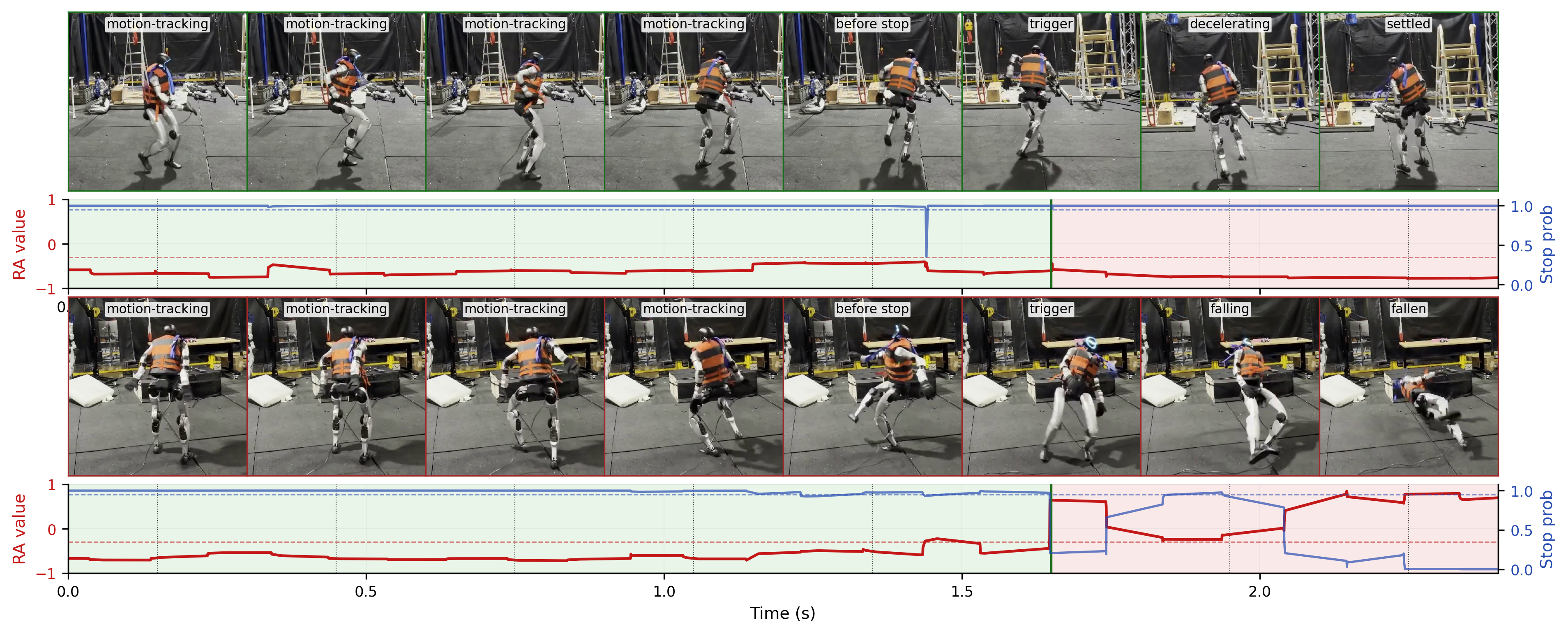
Safe-Stop real robot teaser with recoverable and unrecoverable stopping examples.
Safe-Stop predicts whether an emergency stop is recoverable before committing to the stop policy. Low reach-avoidance value and high stop probability lead to a stable halt; disagreeing estimates trigger a fallback.

Experiment Video

Abstract

Humanoid robots responding to emergency stop commands typically execute a fixed maneuver, without reasoning about whether a safe stop is actually feasible from the current state. We cast emergency stopping as a reach-avoid problem and propose Safe-Stop, a task-agnostic framework that pairs a learned stop policy with learned stoppability estimators. The estimators are complementary: a stop-probability estimator supervised by the actual outcomes of the fixed stop policy, and a reach-avoidance estimator supervised by a Hamilton-Jacobi backup over physical state. The first captures emergent stopping behavior of the learned controller; the second provides a complementary recoverability signal.

Because the stop policy and estimators do not depend on the behavior policy that preceded the stop command, they transfer across diverse upstream tasks without retraining. At deployment, the two estimates are combined: Safe-Stop commits to the stop only when both estimators indicate that stopping remains feasible, otherwise it hands off to a fall policy, instantiated as a damping fallback. This agreement check yields decisions that are robust without sacrificing reactivity, achieving 96.4% out-of-distribution stop success and 3.89% unsafe-approval rate on the Unitree G1.

Framework
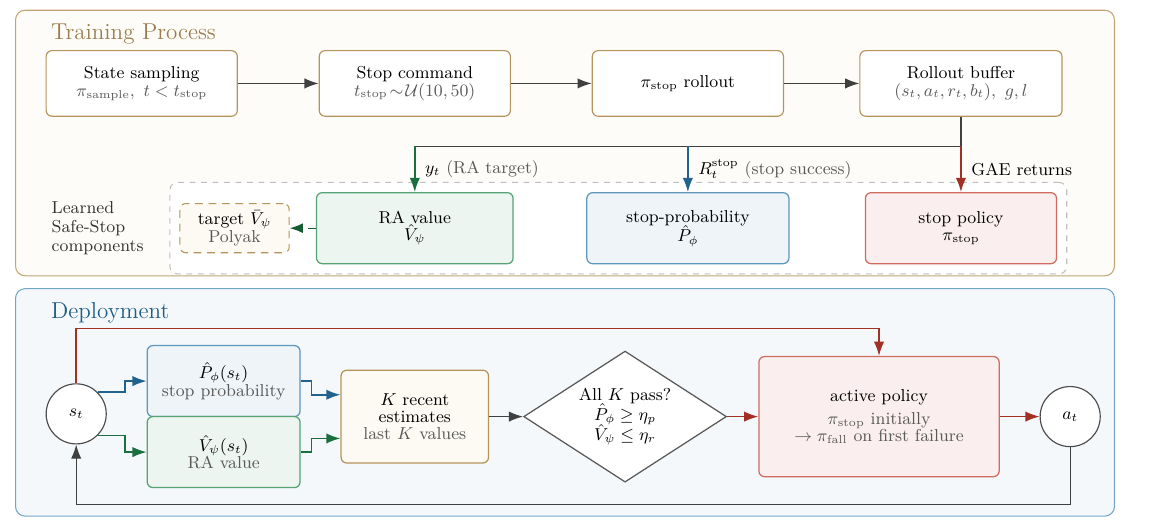
Safe-Stop framework showing training rollouts, learned stop policy and stoppability estimators, and the runtime stop-or-fall decision gate.
Safe-Stop separates how to stop from whether stopping is feasible, allowing a task-agnostic stop policy and its stoppability estimators to transfer across upstream behaviors.

During training, Safe-Stop samples pre-stop states, issues randomized stop commands, and rolls out the stop policy to collect targets for three learned components: the stop policy, the stop-probability estimator, and the reach-avoidance value estimator.

During deployment, the two estimators evaluate the current state over a short recent window. Safe-Stop continues with the stop policy only when all recent estimates satisfy the stoppability condition; otherwise, it switches to the fall policy on the first failed gate.

Results
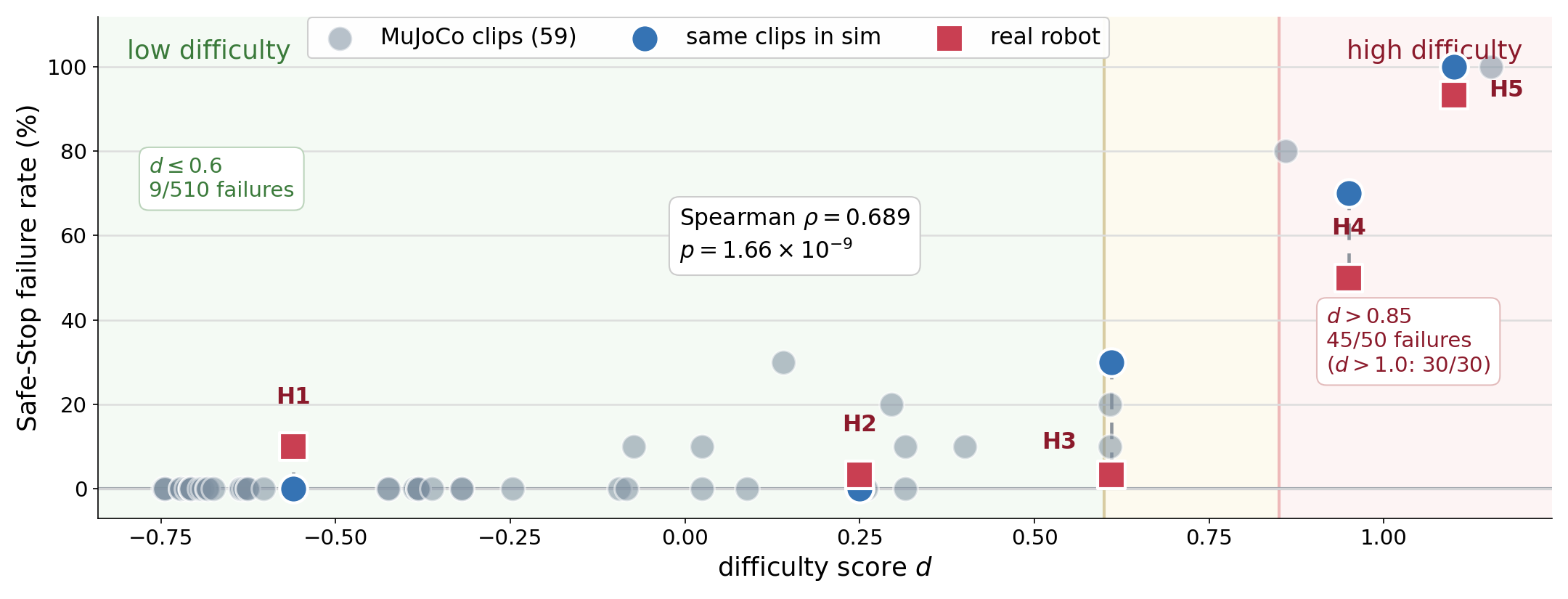
Runtime trigger difficulty score calibration across MuJoCo, simulation, and real robot clips.
The peak reach-avoidance value provides a compact difficulty score for a motion clip. Low-score clips are consistently recoverable, while high-score clips concentrate the failures. Matching the same trigger protocol in simulation and on hardware (30 repeats per clip) shows the difficulty ordering remains consistent on the real robot.
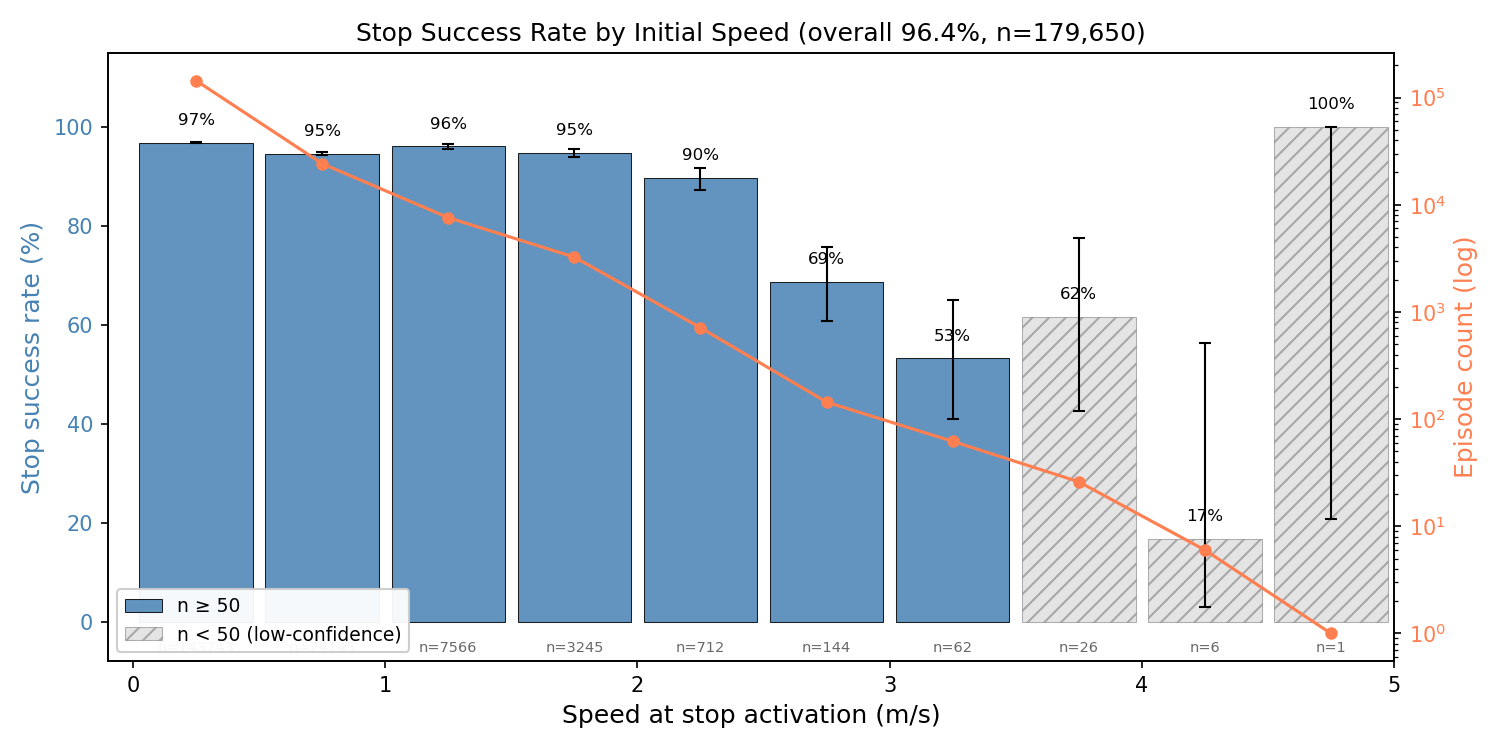
Stop success rate by initial speed.
The stop policy transfers to out-of-distribution motion states and remains reliable across low and moderate activation speeds. Performance degrades at higher speeds, revealing the expected physical recoverability boundary rather than a binary notion of safety.
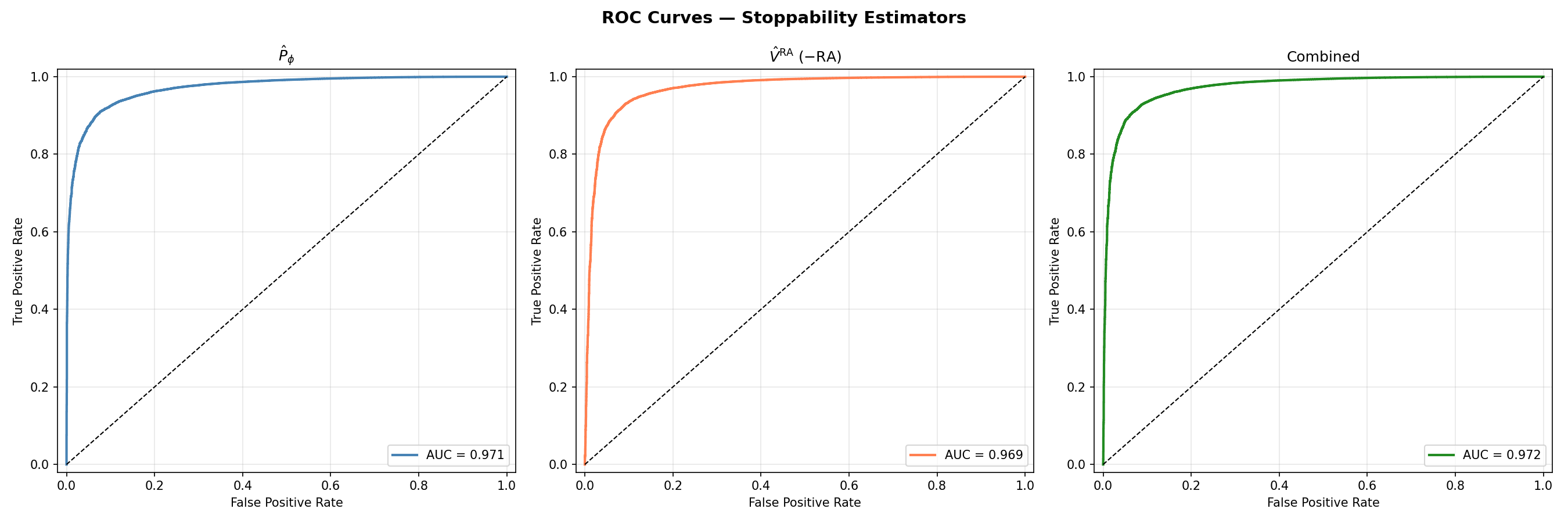
ROC curves for stop probability, reach-avoidance value, and combined classifier.
Both learned signals separate recoverable and unrecoverable stop attempts. The stop-probability estimator captures the empirical behavior of the learned stop controller, while the reach-avoidance value adds a physically grounded danger signal.
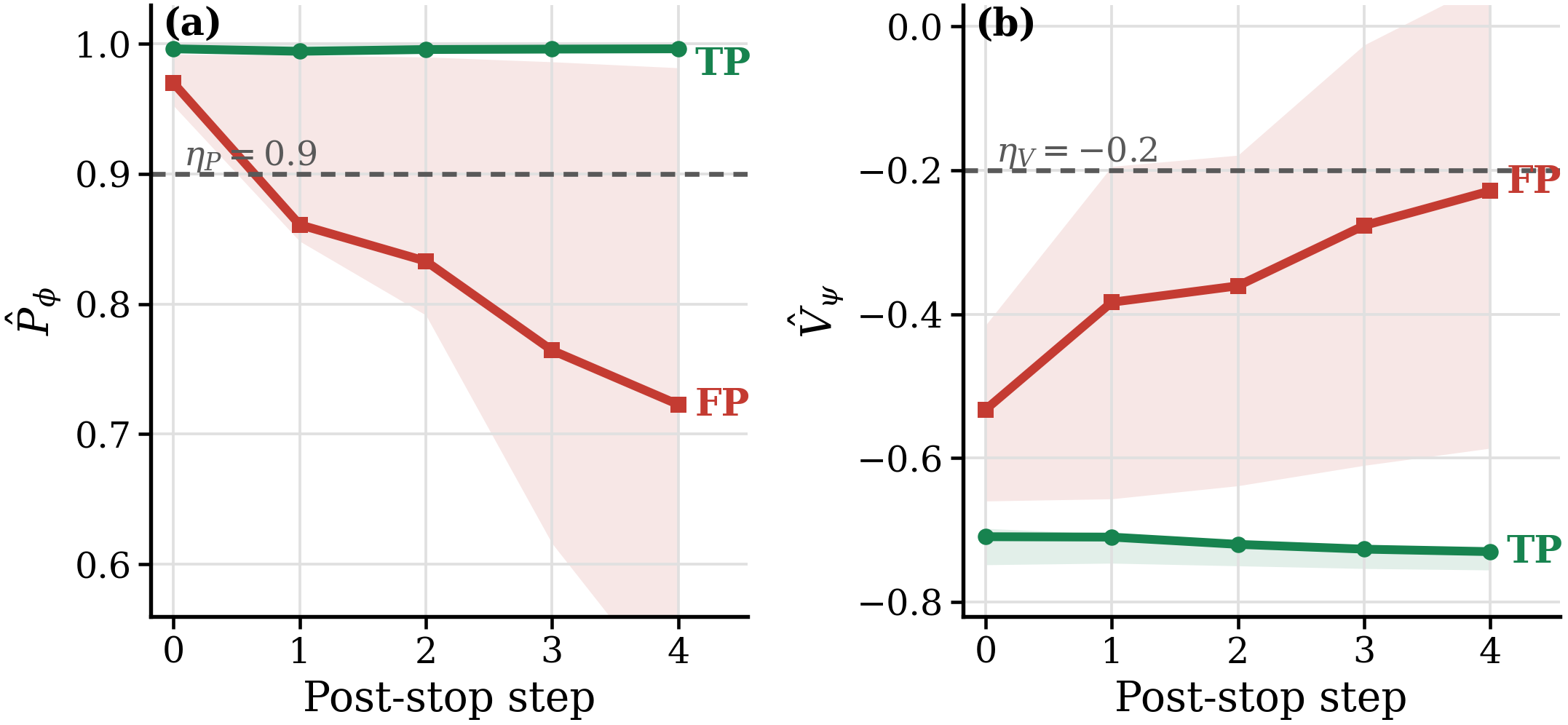
Stop probability and reach-avoidance trajectories for true positives and false positives.
False-positive approvals often look safe at the first decision instant, then quickly lose estimator agreement. Requiring the dual condition to hold over a short window filters these unstable cases while preserving responsive stop decisions.
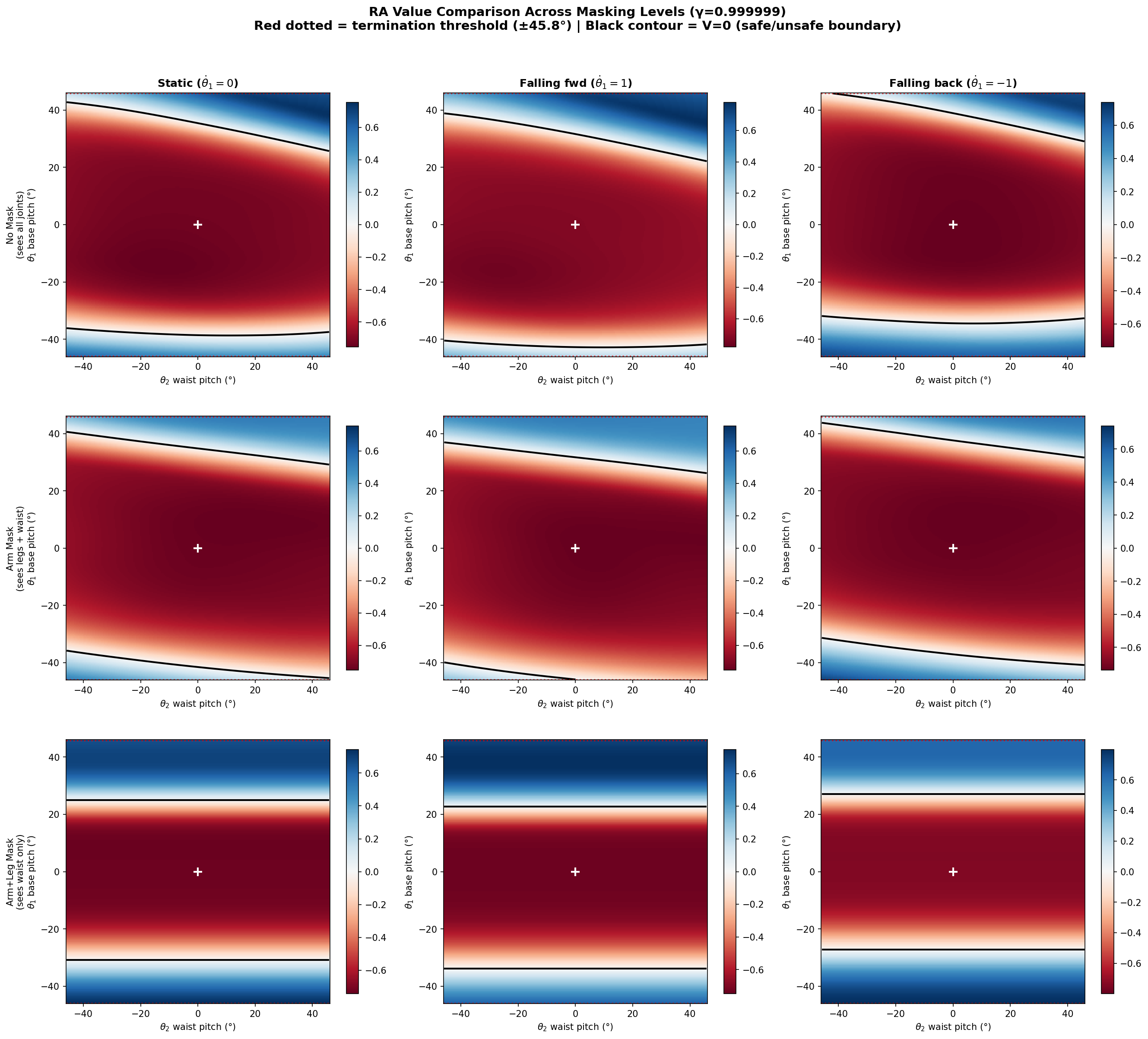
Reach-avoidance value landscapes across observation mask variants.
The reach-avoidance value should vary smoothly with mechanically relevant body and support variables. Masking arm joints preserves this recoverability structure while reducing task-dependent upper-body variation, improving transfer to unseen motion-tracking states without changing the stop policy.

Citation

@article{safestop2026,
  title     = {Humanoid Safe Stop via Learned Stoppability Value},
  author    = {Long, Junfeng and Abbeel, Pieter and Sreenath, Koushil and Horowitz, Roberto and Shi, Guanya and Liu, C. Karen},
  journal   = {arXiv preprint arXiv:2609.02358},
  year      = {2026}
}